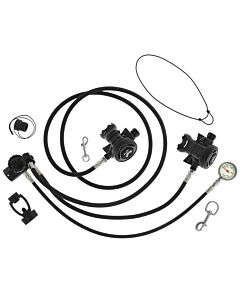
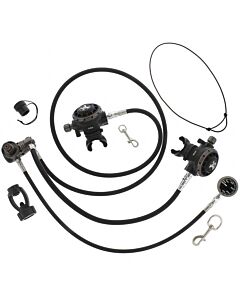
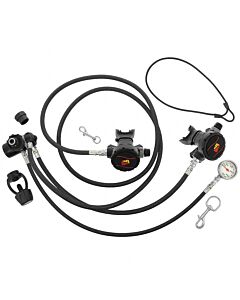
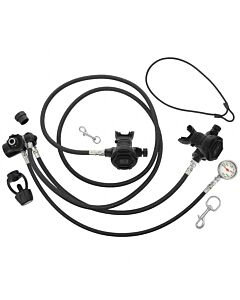
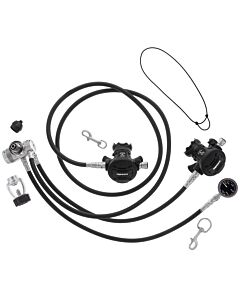
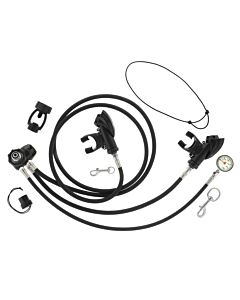
The traditionally configured sport diver uses an 'octopus' regulator
setup. Over time, many experienced divers have come to believe this
configuration has significant problems even for single tank diving. Key
issues are that the backup second stage, on a {36 in | 91 cm} or
perhaps { 40 in | 1 m } hose, is annoying to reliably stow, causes
unnecessary drag, is difficult and time consuming to deploy, and the
hose is often found to be too short in an emergency. Further, it's not
unusual for the octopus to be clogged with silt or sand if not stowed
carefully.
Today, many experienced divers prefer an alternative configuration to
the single tank octopus. Overhead divers use a { 84 in | 2.1 m } hose
and sport divers use a { 60 | 1.5 m } hose for their primary second
stage, and put the backup second stage on a short { 22 in | 60 cm } hose
hung on a necklace directly below their chin. In an emergency the
primary second stage is donated with one hand while the backup is
instantly available as a replacement using the other hand. With a bit of
practice, some divers have even perfected a skill that allows them to
retrieve the backup without using their hands at all!
The long hose routes down the divers right side behind their back,
under their right arm, up and across the chest to the left shoulder,
behind the neck and around to the mouth. The backup second stage has a
short hose and hangs on a necklace directly below the chin. The high
pressure hose for the SPG is shorter as well; routed straight down the
divers left back side and the SPG is clipped to the waist D-ring. The BC
inflation hose also a shorter length appropriate for the shorter BC
inflation assembly found on back inflation wings.